
Which Type of Dryer is Used for Paddy Drying?
Release time: 2025-12-10
Table of Contents
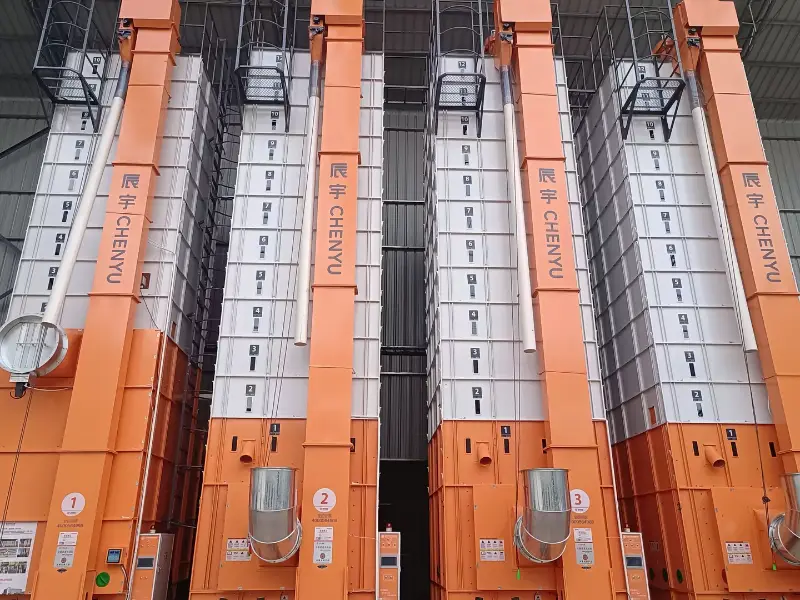
In the modern grain processing industry, rice drying is a crucial step in ensuring grain quality and improving storage safety. With the continuous improvement of agricultural mechanization, various paddy dryer machines have emerged on the market, including automated paddy dryers, batch circulation dryers, continuous dryers, and tower dryers. Each type of equipment has its advantages, so which dryer is best suited for rice drying? Chenyu will provide a comprehensive analysis to help users choose the most suitable and efficient paddy drying equipment.
Batch Circulation Dryer
The batch circulation dryer is one of the most widely used paddy drying equipment. Its characteristic is that the paddy is loaded into a drying chamber and repeatedly dried through hot air circulation, resulting in a uniform reduction of moisture content.
Advantages:
Simple operation, suitable for small and medium-sized grain processing enterprises.
Uniform drying process, reducing the rate of rice cracking.
Can be combined with an automatic control system to form an automated rice dryer.
Batch-type circulating dryers are particularly suitable for seasonal drying needs, not requiring continuous 24/7 operation, offering good flexibility.
Tower Dryer
Tower dryers are one of the most mature solutions in the grain drying industry and are the mainstream choice for modern grain depots and large grain traders. Their compact structure makes them suitable for large-scale continuous operation.
Advantages:
Suitable for large-volume rice processing.
High automation and stability.
High heat utilization rate, relatively low energy consumption.
Easier to integrate into advanced rice dryer systems.
Tower dryers are most effective in scenarios requiring large-volume, rapid drying, especially suitable for intensive farms and large processing plants.
Continuous Flow Dryer
Continuous flow dryers automate the entire process of rice drying from feeding and drying to discharge, and are a high-efficiency rice drying equipment that has emerged in recent years.
Advantages:
Suitable for large-scale continuous production
Fast drying speed and high efficiency
Enables more precise temperature and humidity control
Can be connected to an intelligent control system, upgrading to an intelligent paddy dryer
This equipment is particularly suitable for enterprises requiring 24/7 continuous production, greatly helping to stabilize production capacity and improve efficiency.
Fluidized Bed Dryer
Fluidized bed dryers use high-speed hot air to “blow up” the paddy rice, creating a fluidized state and achieving rapid and uniform heat exchange.
Advantages:
Extremely fast drying speed
Low cracking rate, maintaining paddy rice quality
Suitable for high-quality paddy processing plants
These advanced paddy dryers are often used in markets with higher quality requirements, such as high-grade rice producers.
Which dryer is best for paddy rice?
Choosing the best paddy dryer machine depends on the following factors:
Production scale: Small production volumes are suitable for batch processing; large production volumes are recommended for tower or continuous systems.
Budget and energy consumption: Continuous and tower dryers are more energy efficient, but have higher investment costs.
Rice Quality Requirements: Fluidized bed dryers are recommended for high-quality processing.
Automation Requirements: For automated management, tower or continuous intelligent rice drying solutions are preferred.
Conclusion
Different types of paddy dryers each have their advantages; there is no absolute “best,” only the one most suitable for your application scenario. Whether it’s an automated paddy dryer, an advanced paddy dryer, or an economical batch dryer, proper selection can significantly improve drying efficiency and rice quality. Hopefully, this article will help you better understand various paddy dryer machines and provide a reference for subsequent procurement and production management.